Client Stories
Altyn Dala
How The Earthshot Prize Winner 2024, Altyn Dala is using eDNA to pilot monitoring and restore freshwater ecosystems across Kazakhstan’s 7,000 Rivers rivers and innumerable wetlands.
55
vertebrate species identified across remote wetlands and rivers, a baseline for the newly designated 657,000-hectare Bokey Orda State Protected Area in West Kazakhstan
Saiga antelope
an Altyn Dala flagship species, detected at 20 sites beyond expected seasonal range, revealing freshwater habitat use, informing protection strategies
First
comprehensive freshwater baseline for a protected area in a region with decades of major data gaps

Company
Altyn Dala
The Altyn Dala Conservation Initiative is a longstanding formal partnership to conserve and restore the vast steppe landscapes of Kazakhstan.
Sector and Environment
Conservation & Forestry
Freshwater Rivers
Sample type
Aquatic

Mark Day
Co-Founder, Altyn Dala Conservation Initiative
"Using environmental DNA is by far the most practical and cost-effective tool for our joint freshwater research to inform the Government of Kazakhstan’s protected areas expansion and site management planning alongside wider species recovery work, and we are co-designing future work to extend our collaboration to build understanding and inform future scaling up of action in vital freshwater ecosystems."
Overview
Kazakhstan has 7,000 rivers. For most of them, comprehensive biodiversity data doesn't exist. Decades of Soviet-era fish introductions and lost records left huge knowledge gaps about native species distributions. For the Altyn Dala Conservation Initiative - winner of The Earthshot Prize and a UN Decade of Ecosystem Restoration Flagship - this created a fundamental problem: How do you manage and restore freshwater ecosystems when you don't know what's in them?
The newly established Bokey Orda/Ashiozek State Protected Area spans 657,450 hectares of West Kazakhstan's steppe, wetlands and rivers. It's part of an enormously ambitious plan to manage and restore over 75 million hectares of steppe grasslands and wetlands. The Altyn Dala’s partners the RSPB, the Association for the Conservation of Biodiversity of Kazakhstan (ACBK) and the Government of Kazakhstan needed a monitoring approach that could be deployed rapidly, with the potential for scaling nationally, and operated by local teams without extensive taxonomic training.
The challenge
Across Kazakhstan's 7,000 rivers and countless wetlands, comprehensive freshwater biodiversity data remains extremely limited. Soviet-era fish introductions between 1936 and 1991 altered natural communities significantly, and the vast and remote areas, makes systematic monitoring challenging. For conservation organisations working at landscape scales, understanding freshwater biodiversity and measuring restoration success requires robust baseline data.
Conventional methods offer limited solutions in this context. Many of the protected areas, and areas being assessed for major expansions of the network, are remote and difficult to access, requiring significant logistical planning and resources. Electrofishing requires specialist equipment. Visual surveys miss cryptic species frequently. Each taxonomic group needs different specialists, and many taxa have no one nationally. Covering even a fraction of the 657,000-hectare protected area using conventional approaches would cost hundreds of thousands of pounds and take multiple field seasons. Altyn Dala needed monitoring that local teams could deploy across vast areas, that worked across all species groups simultaneously, and that could be standardised and scaled nationally.
Our role
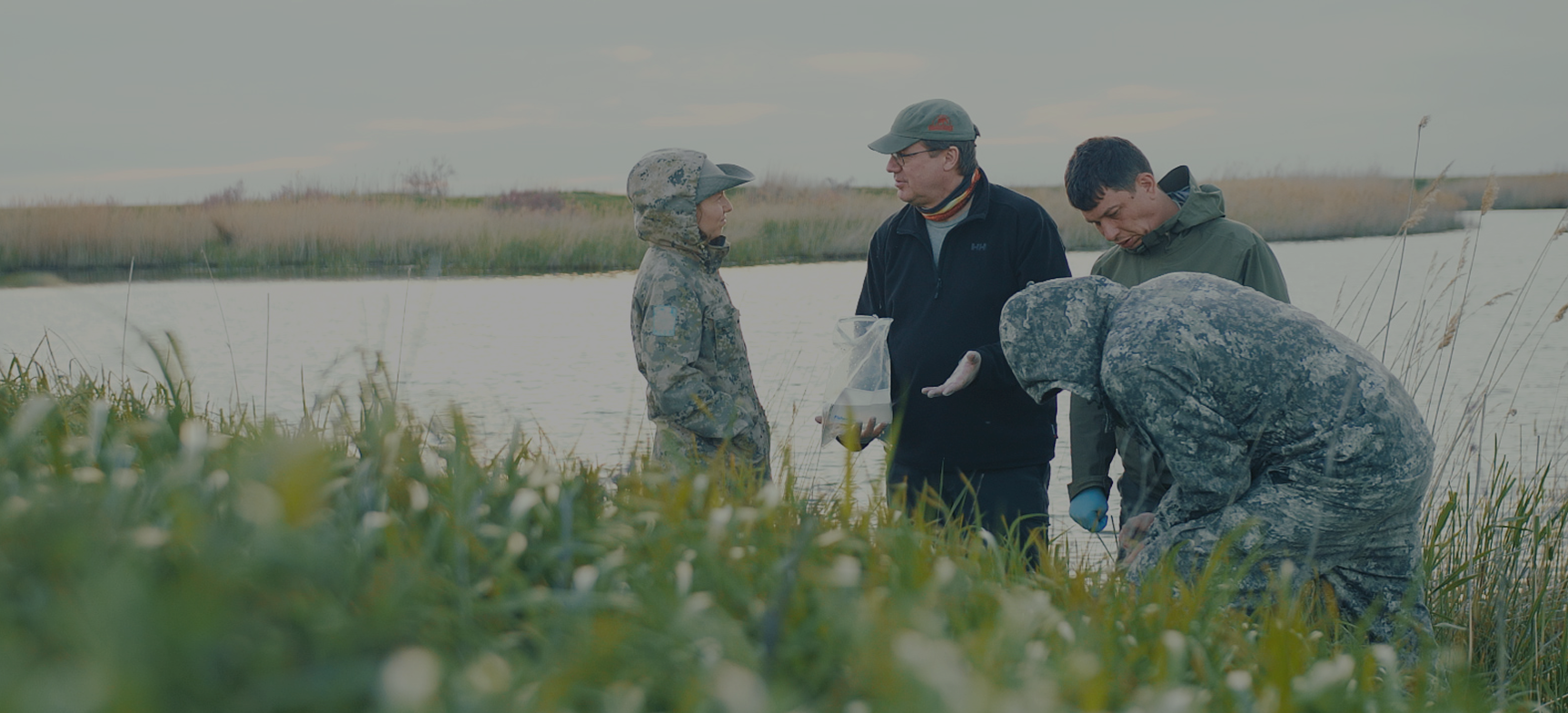
NatureMetrics supported the ACBK team with effective survey design across the region. During their 2022 fieldwork, teams collected 50 water samples. Adding eDNA sampling required minimal time: collect water, filter it, post the filter to NatureMetrics. No specialist equipment beyond the kits. No need to catch or identify animals.
NatureMetrics processed the samples using vertebrate metabarcoding, detecting DNA from fish, amphibians, birds, and mammals. Additionally, 15 tissue samples from organisms found during fieldwork were sequenced to improve the global reference library. The result: 55 taxa including 9 fish species, 9 birds, 4 mammals and 1 amphibian.
This demonstrated that local conservation teams, without taxonomic specialists, could generate robust biodiversity data across vast, difficult-to-access landscapes using methods simple enough to integrate into existing fieldwork.
The findings
Prussian carp, introduced during the Soviet era, accounted for 56.7% of all DNA sequences and appeared in 43 of 50 samples. The data also revealed significant native biodiversity. The iconic saiga antelope appeared in 20 samples, including locations beyond its expected seasonal range for that time of year. This discovery provides valuable information about habitat use and movement patterns that can inform conservation management strategies for this iconic species, which has experienced a truly dramatic population recovery in recent decades.
Unsurprisingly Eurasian coot appeared in 23 samples as a common bird in rivers and wetlands. The data also captured cryptic fish species, highly mobile birds, and mammals that would be nearly impossible to survey conventionally in this remote landscape.
Average species richness was 9.42 taxa per sample, ranging from 1 to 23. This revealed which wetlands supported the most diverse and most natural communities, informing where to focus on restoration efforts, and where native communities remain relatively intact despite historical introductions.
Most importantly, the findings established a comprehensive baseline. For the first time in Kazakhstan (and across Central Asia), there's a quantified, standardised record of what in these freshwater systems against which future surveys can measure management effectiveness and restoration success.
The impact
The Altyn Dala Conservation Initiative is now exploring how to expand monitoring across other priority ecosystems within the 75-million-hectare landscape. This approach is designed to enable strategic eDNA deployment to answer specific management questions: Where are native fish communities most intact? Which wetlands support the highest diversity? Are management and restoration interventions working, and if so, which are working best?
The implications extend beyond conservation. Kazakhstan's freshwater systems support local livelihoods, food security and cultural practices. Knowing which species are present and where creates opportunities for smarter fisheries management, better targeting investments in new protected areas, and earlier detection and control of invasive species or pollution.
For other countries working at similar scales across remote landscapes, this project is proving that you can establish national-scale freshwater monitoring systems without armies of taxonomic specialists, train local teams to collect robust biodiversity data across difficult terrain, and fill knowledge gaps efficiently. The technology is ready. The methods are proven. What's needed now is the leading organisations like Altyn Dala to deploy them at scale.
More client stories
Learn how NatureMetrics’ data and insight empowered businesses
with the clarity they needed to make lasting change

HECTAR
Proving what works: How HECTAR is building the monitoring standard for regenerative agriculture
Read more →

Wildfarmed
126% increase in pollinator activity: how Wildfarmed proved regenerative farming works
Read more →

AtkinsRéalis Mongolia
How AtkinsRéalis used eDNA to enhance biodiversity assessment for irrigation investment in Mongolia
Read more →Ready to build a nature strategy on evidence you can defend?
Tell us where you are and what your board, auditors or investors are asking for. We will map the fastest route to decision-grade answers.