Client Stories
Coast4C
How Coast4C is building a blue economy by regenerative seaweed farming on the world's rarest double barrier reef.
1,082
Species detected in a week that would require months of conventional survey
9 IUCN
Vulnerable and Near-Threatened species confirmed, including Tiger Tail Seahorse and Vulnerable groupers
Year 1
Baseline established for ongoing reef and fisheries recovery monitoring on the Danajon Bank

Company
Coast4C
Coast 4C is a supplier of quality, responsibly sourced seaweed, solving the supply challenges for responsible global brands across multiple applications.
Sector and Environment
Conservation & Forestry
Marine
Sample type
Aquatic

Nicholas Hill
Co-founder, Coast4C
“This data is going to be so useful for local authorities and the communities - everyone who looks after these waters. We’re able to look at biodiversity in areas that you cannot easily access or evaluate with traditional survey methods, and get such a comprehensive picture of what is going on”
Overview
The Danajon Bank is the Philippines' only double barrier reef and one of the most biodiverse, most threatened marine ecosystems in Southeast Asia.
Coast4C is building a blue economy here, pairing regenerative seaweed farming with marine protection and community livelihoods. Nature Metrics deployed eDNA across 64sites and six habitats to establish the baseline that will track whether it's working.
The challenge
The Danajon Bank supports thousands of fishing families and one of Southeast Asia's most biodiverse marine ecosystems. Coast4C's model of regenerative seaweed farming paired with community-managed No-Take Zones represents a new kind of blue economy, but demonstrating impact to conservation finance investors requires verified, repeatable biodiversity data gathered by aglobally scalable, community-operable methodology. Conventional reef surveys are expensive, ecologically disruptive, and far too slow to deliver it.
Our role
NatureMetrics designed a 64-site aquatic eDNA survey across six habitat types — the wild reference reef, the community No-Take Zone, ecological seaweed farm zones, conventional seaweed farm areas, mangroves, and deep water spillover.
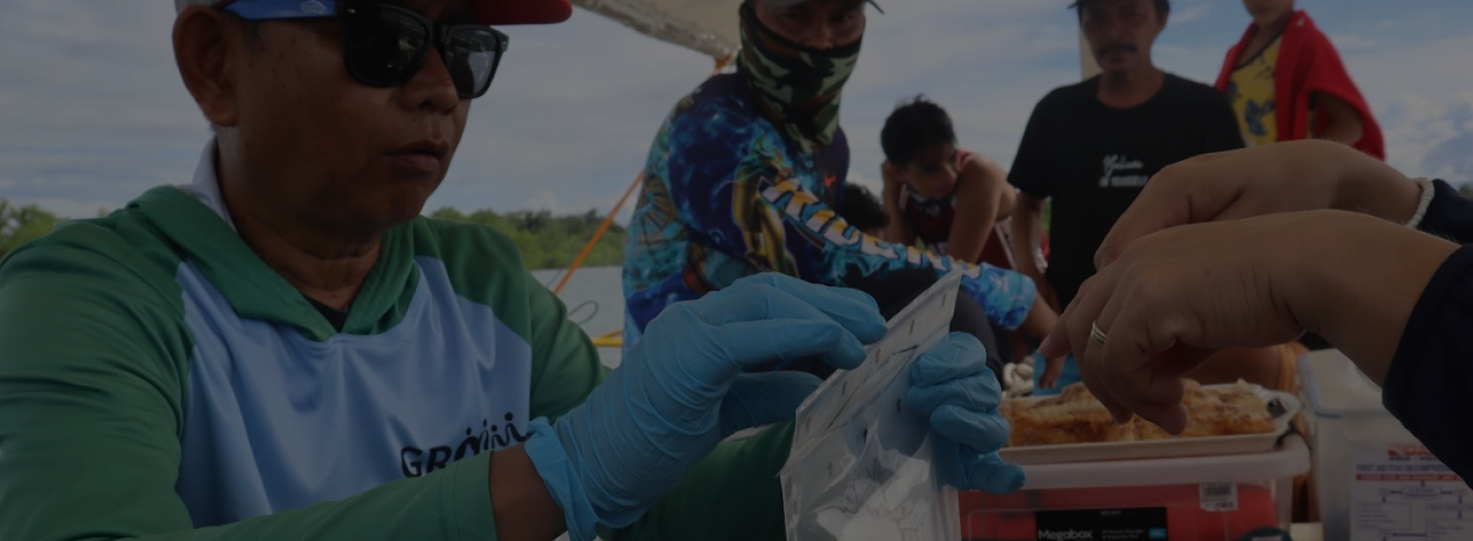
In a single field week, 64 water samples were collected from boats around Jandayan Island by Coast4C's team and local high school students, connecting the next generation of islanders with their ecological heritage. Fish and eukaryote community analysis was run on the NatureMetrics Intelligence Platform, with full results returned within 8 weeks.
The findings
Reading 5.3 million DNA fragments, the survey detected more than 1,000 distinct kinds of life across all five kingdoms, from reef-building corals to apex predators including Giant Trevally. Of 228 fish species confirmed across 74 families, 9 appear on the IUCN Red List as Vulnerable or Near-Threatened, including Squaretail Coral Grouper, Bear Paw Giant Clam, and Tiger Tail Seahorse, sensitive indicator species whose presence signals intact ecosystem function and low extraction pressure.
Critically, the ecological seaweed farm zones returned the highest fish species count of any habitat surveyed: 322 species, on par with the fully protected No-Take Zone, and meaningful biodiversity differences were found between reference reef, no-take zones, and farmed areas, giving Coast4C a rigorous, habitat-by-habitat picture of ecosystem health.
The impact
The Year 1 results establish an incredibly comprehensive biodiversity baseline —giving Coast4C the evidence base to demonstrate that regenerative farming and reef recovery are compatible, not competing. The data is already being shared with municipal aquaculture officers and local community groups, and forms the foundation for ongoing monitoring that will track fisheries recovery over time.
For investors and conservation finance partners, the platform-delivered results translate directly into the kind of verified, repeatable biodiversity metrics needed to unlock nature-based financing instruments, drive marine protected area designation,and support TNFD-aligned disclosure.Crucially, the survey design is replicable: as Coast4C scales its mission to new sites, the same eDNAmethodologycan be deployed by local community partners, generating consistent, comparable data that builds the longitudinal evidence base for reef and fisheries recovery over time.
In collaboration with: Coast4C, local community partners on the Danajon Bank, Jandayan Island MPA community groups.
More client stories
Learn how NatureMetrics’ data and insight empowered businesses
with the clarity they needed to make lasting change
HECTAR
Proving what works: How HECTAR is building the monitoring standard for regenerative agriculture
Read more →

Wildfarmed
126% increase in pollinator activity: how Wildfarmed proved regenerative farming works
Read more →

AtkinsRéalis Mongolia
How AtkinsRéalis used eDNA to enhance biodiversity assessment for irrigation investment in Mongolia
Read more →Ready to build a nature strategy on evidence you can defend?
Tell us where you are and what your board, auditors or investors are asking for. We will map the fastest route to decision-grade answers.