Client Stories
Fujitsu
How Fujitsu detected 2000+ unique species on their corporate campuses and created a TNFD-ready baseline with eDNA

2,352
unique species detected across two corporate campuses
20
CHEGD fungi and 4 UK Red List vertebrates (Badger, Common toad, Goldcrest, Muntjac) confirmed on corporate land
Global Nature Risk
screening trialled across Fujitsu's wider site portfolio to prioritise which nature risks to act on first

Company
Fujitsu
Fujitsu is a global Japanese technology company that leverages AI, computing, network, and data & security capabilities to help organisations build a more sustainable, trusted society through innovation.
Sector and Environment
Consumer & Agriculture
Grasslands
Heathlands
Sample type
Soil

Victoria Ward
Head of Environmental Impact & Sustainability Lead
"We had clear ambitions to reduce our impact on biodiversity, but what we lacked was a meaningful baseline to measure progress against. Working with NatureMetrics has changed that—giving us robust, science-based data that enables us to truly understand our impact and take informed action."
Overview
Fujitsu's main aim was to create a biodiversity baseline that could feed disclosure frameworks and Fujitsu's Biodiversity Commitments. With the help of eDNA and a low-footprint method, they got much more than they bargained for - a scalable blueprint utilising their otherwise overlooked corporate campuses.
The challenge
Corporate campuses are some of the most overlooked landscapes in nature reporting— assumed low-value, with no evidence either way. Conventional ecological surveys are slow, expensive and depend on specialist field teams, which is impractical to repeat consistently across a global estate.
Fujitsu required biodiversity metrics that non-specialists could collect in minutes, that produced comparable results from one site to the next, and that could be integrated directly into sustainability reporting frameworks such as TNFD and CSRD and help meet their own nature targets.
Our role
We partnered with Fujitsu to run a single, end-to-end eDNA programme across two contrasting UK campuses, Stevenage and Wakefield, using one standardised, low-footprint methodology.
Anybody can collect an eDNA sample, and in this case it was non-ecologists from the Sustainability Team at Fujitsu who were able to easily collect the surface swab eDNA samples by swabbing leaves, branches and grass around the natural spaces to capture the vertebrate community, alongside collecting simple soil cores to capture the fungal and bacterial communities below ground. In our laboratories, DNA was extracted and sequenced through the NatureMetrics pipeline.
Results were presented on the NatureMetrics Platform as structured species lists and scientifically validated biodiversity metrics, ready to feed TNFD, Nature Positive and CSRD reporting. Throughout, we provided technical support and data interpretation so the insights could be woven directly into Fujitsu's broader sustainability approach.
The findings
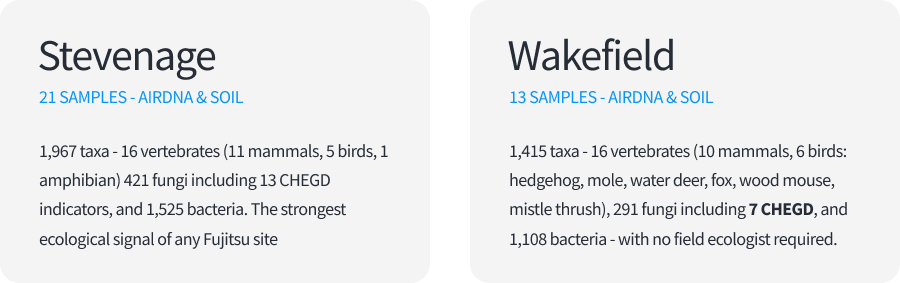
From just 34 samples, the pilot detected 2,352 unique species spanning the entire campus food web, many of them small, common and rarely recorded. The charismatic species make headlines, but eDNA's real power is breadth and roughly 78% of detections were soil bacteria, 21% fungi and around 1% vertebrates, with the CHEGD fungi and Red List vertebrates together making up under 2% of the total.
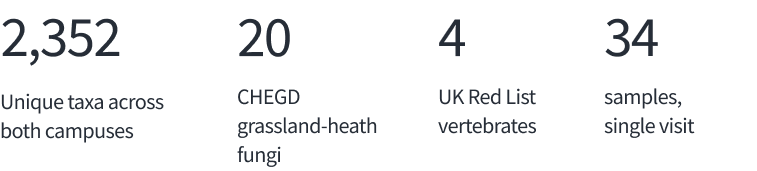
The flagship signal was below ground. The presence of CHEGD species (from groups of Clavarioid, Hygrocybe, Entoloma, Geoglossoid and Dermoloma fungi) is the recognised marker of long-established, healthy grassland. Detecting 20 CHEGD species across two corporate campuses reframes routine grounds as biodiversity assets worth managing. Surface swab samples confirmed four UK Red List vertebrates, and invasive species were flagged at both sites, acting as an early-warning signal for grounds and facilities teams.
The impact
Fujitsu now holds defensible, third-party biodiversity evidence for two UK corporate sites where there was previously none. The baseline feeds directly into the ‘Assess’ stage of the TNFD LEAP process and populates Nature Positive State-of-Nature metrics with real site data, moving Fujitsu's biodiversity commitments from intent to evidence — and because the methodology is standardised, it stays directly comparable over time as new samples come in.
NatureMetrics also delivered an internal impact webinar to Fujitsu's global teams, building biodiversity and nature-risk literacy beyond the sustainability function.
Most importantly, the pilot proved a model. What worked at Stevenage and Wakefield is a low-footprint workflow that drops into any corporate site. An easy, affordable entry point to disclosure-ready biodiversity data. On the strength of it, Fujitsu is progressing the partnership beyond the UK into three further countries, carrying the same methodology and the same evidence base into the wider estate. As a next step, they're also trialling Global Nature Risk screening and Global Nature Performance monitoring at a number of sites to prioritise where eDNA and biodiversity investment go next.
More client stories
Learn how NatureMetrics’ data and insight empowered businesses
with the clarity they needed to make lasting change

HECTAR
Proving what works: How HECTAR is building the monitoring standard for regenerative agriculture
Read more →

Wildfarmed
126% increase in pollinator activity: how Wildfarmed proved regenerative farming works
Read more →

AtkinsRéalis Mongolia
How AtkinsRéalis used eDNA to enhance biodiversity assessment for irrigation investment in Mongolia
Read more →Ready to build a nature strategy on evidence you can defend?
Tell us where you are and what your board, auditors or investors are asking for. We will map the fastest route to decision-grade answers.